

Magic Wands and Morphing Mallets: A Day with Mark Goldstein Featuring the Lightning Wands & Marimba Lumina
Magic Wands and Morphing Mallets: A Day with Mark Goldstein Featuring the Lightning Wands & Marimba Lumina
Share this event
Magic Wands and Morphing Mallets: A Day with Mark Goldstein Featuring the Lightning Wands & Marimba Lumina
Mark Goldstein began working and touring with Don Buchla in 1991, the year that Buchla’s Lightning Wands were introduced. He later played a key role in the creation and development of the Marimba Lumina, which debuted in 2000. Join us as Goldstein leads a day-long experience that includes two lecture-demonstrations where he will discuss the technical features and evolution of the Lightning Wands and Marimba Lumina.
The Buchla Lightning Wands were developed by Don Buchla as a gestural controller: you play them by holding a wand in each hand and waving them around in the air. As instruments that generate sound based on the artist's motion in empty space, they bear a close relationship to the Theremin, which was invented in 1920.
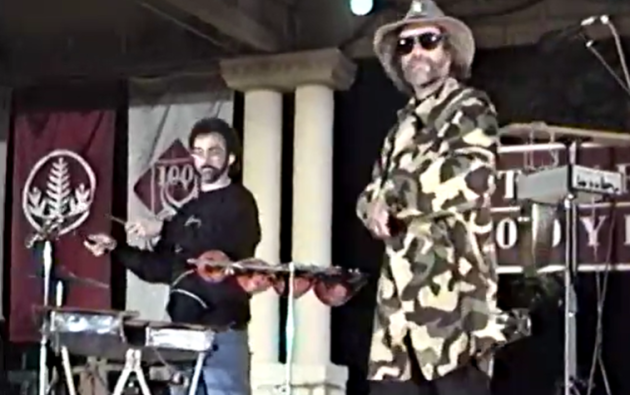
After creating the Lightning Wands, Don Buchla approached Goldstein, a percussionist by trade, and asked him to help create a musical piece that could showcase their capabilities. Together they wrote En Plein Vol (a.k.a. Thief), a whimsical piece in which a musician appears to be playing several traditional acoustic percussion instruments on stage but the actual music is coming from the Lightning Wands. A thief (played by Buchla himself in the original performance), slowly steals the acoustic instruments one by one, but the music just keeps going as the Lightning Wands continue to play in the empty space where the instruments used to be. When En Plein Vol premiered in 1991, at a concert celebrating Stanford University’s centennial, audiences were stunned to see "drumsticks" making sound in empty space, and the piece quickly became iconic in the computer music community.
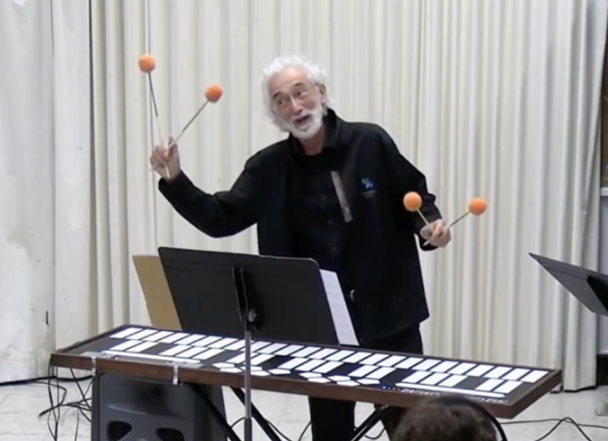
After working with Buchla and the Lightning Wands, Goldstein started to think about building something new for orchestral percussionists like himself. He envisioned a more traditional mallet instrument that could be used to control synthesis using the familiar four-mallet technique employed by marimba and vibraphone players. This would be an alternate controller of a very different sort: he dreamed of a mallet controller that could identify which mallet hit a bar (so each mallet could have its own sound), where on the bar it hit, and how it hit (down/up/damp/dead strokes). He wanted a controller that could track a mallet sliding on a bar and offer a large four-octave range with a curved keyboard for comfort. Goldstein proposed the idea to Don Buchla, and over the course of a year with much lobbying, Don finally agreed to try his hand at what became the Marimba Lumina . . . as long as Goldstein agreed to program it. The result is an intuitively obvious mallet keyboard controller, with expressive capabilities that leverage ordinary mallet technique. Not quite as exotic as the Lightning Wands, but equally amazing.
For this day-long event, Goldstein will present two separate afternoon lecture-demonstrations: the first on the Lightning Wands and the second on the Marimba Lumina. Both sessions will include short performances demonstrating the capabilities of the instruments and attendees will be invited to come up and try playing them as well. A few volunteers from these sessions who are willing to stay and rehearse over the dinner break will be offered the opportunity to perform with Mark in the evening event.
The evening event will be an interactive workshop/performance featuring recreations of several historic pieces for Lightning that Goldstein and Buchla performed back in the 1990s, along with some of Goldstein's own compositions for the Lightning and Marimba Lumina. Volunteers from the afternoon sessions will be featured in some of the pieces and additional participants will be selected on-the-spot from the evening audience.
Although they are among his lesser-known creations, both the Lightning Wands and Marimba Lumina demonstrate the technical wizardry and genius of Don Buchla, who always meant his creations to be truly playable and expressive musical instruments. Over the course of all three sessions, Goldstein will offer personal insight into how the malleability of these instruments, due to their unique gesture-capturing abilities and programmability, led him on an exciting path of musical exploration, expressivity, and virtuosity -- and how that journey ultimately allowed him to forge a relationship with Buchla's instruments that is every bit as deep and rewarding as a lifetime spent with any traditional one.
There is no admission fee but donations are gratefully received. Please be sure to select each session you plan to attend when registering. Note that a small booking fee is added to concerts/performances to help cover costs and minimize no-shows. Seating is limited, so please contact us if you have signed up and can no longer attend so we can make your seats available to others (if you paid a booking fee, it will be refunded if you give up your seats.)
1:00-2:15pm The Evolution of Lightning Wands, 1991 to the Present
In this lecture-demonstration, Goldstein gives an overview of the Lightning Wands: what they are, how they work, their gestural vocabulary, and the design changes from Lightning I to Lightning II. The presentation will feature the Lightning I and Lightning II from EMEAPP's collection
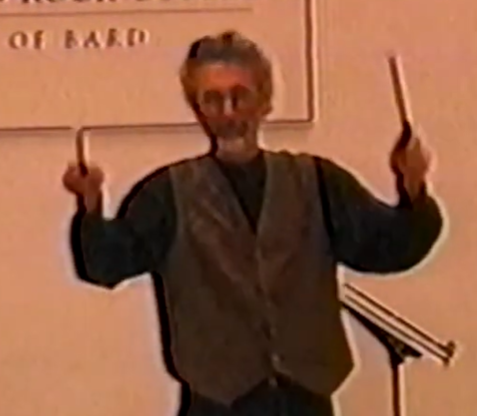
Working with the wands in live performance, Goldstein came to realize the importance of "gestural coherence” - the satisfying or confusing relationship between what you see a player doing and what you hear. Coherence plays a large role in Goldstein's use of Lightning and he’ll speak a lot about that.
Starting with the simple “air drum” use of the wands in En Plein Vol, Goldstein will discuss the evolution of his playing techniques and the many ways he's used the Lightning Wands, including orchestra concerts, theatrical productions, silent movie accompaniment, and rehabilitative medicine/music therapy work. He’ll perform live musical examples and members of the audience will be invited to participate.
2:30-4:30pm The Marimba Lumina: From Dream to Reality and Beyond
This two hour session will begin with the story of Goldstein's initial vision of the “Chromaphone" and how it ultimately became the Marimba Lumina. He’ll demonstrate the basic mallet gestures the Lumina recognizes, and show how they can be mapped to produce a variety of musical moves - from the ordinary to the exotic.
He'll explain the difference between the original Marimba Lumina Gold in EMEAPP's collection and the later smaller, commercial models, the 3.5 and 2.5 octave products.
The Lumina was briefly produced in association with a third party, Nearfield Multimedia. That sort of collaboration was unusual for Buchla, and Goldstein attended a variety of trade and professional shows to demonstrate the instrument. Unlike Lightning, the Marimba Lumina was thought to be a “no brainer” for mallet players. Goldstein was privileged to show the instrument to a variety of top mallet players - and their questions and inability to understand the instrument surprised him.. He’ll share some stories about the difficulty of introducing a new instrument to the world
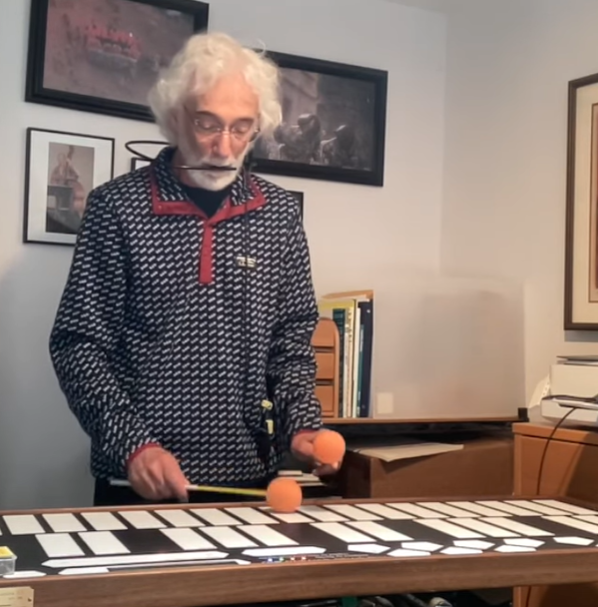
Goldstein will also demonstrate how he has combined a breath controller with the Lumina to create the MarimbaLodica: a wind instrument like a melodica, but monophonic like a flute, and played with mallets like a marimba. The combination of continuous breath control, ballistic mallet strokes, and a monophonic sound source leads to a larger conversation about gestural coherence and the interplay of technique and technology.
Throughout the talk, there will be multiple opportunities for audience members to come up and try playing the Lumina.
* * * A few volunteers from both sessions who are willing to stay and rehearse over the dinner break will be offered the opportunity to perform with Mark in the evening event. * * *
NOTE: For everyone except the volunteers above, the building will close after the lecture and reopen at 7:30 for the evening event. We are happy to provide recommendations for area restaurants for dinner!
8:00pm Interactive Workshop/Performance
The evening will feature recreations of several historic pieces for Lightning that Mark and Don performed back in the 1990s, along with some of Mark’s own compositions for the Lightning and Marimba Lumina. Volunteers from the afternoon sessions will be featured in some of the pieces and additional players will be selected on-the-spot from the evening audience. This will be a fun and relaxed event – and if you’ve ever dreamed of playing a Buchla instrument on stage in front of an audience, this is your once-in-a-lifetime chance!
MARK GOLDSTEIN
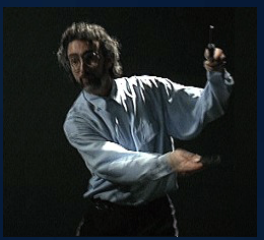
Mark Goldstein is a performer, computer scientist, and instrument designer whose collaborations with Buchla in the 1990s and 2000s helped redefine how humans and electronics interface to make music. He often performs with the Lightning Wands and Marimba Lumina with a diverse collection of musical groups. Mark holds degrees from Johns Hopkins, Peabody Conservatory, and Stanford University and has worked at the computer music centers CCRMA, IRCAM, and CNMAT. He was also one of the developers who pioneered some of the first Digital Audio Workstations (for Sony and Studer), and was dubbed the CXO (chief xylophone officer) of Google - for playing the Marimba Lumina in the cafes and lobbies during his time there.

This event is part of EMEAPP/MMT's special exhibition Instruments That Talk Back: Celebrating the Legacy of Don Buchla. Funding for this exhibition has been provided by The Pew Center for Arts & Heritage. We are deeply grateful for their support.
Location
Museum of Music Technology, 19438